Showing posts with label the writing life. Show all posts

Wednesday, May 25, 2011

Hearts to Bossypants

After each quarter I need a decompress book. By this I mean a book that would never be taught in an English Literature class, yet smart so it keeps my interest.


Enter Bossypants by Tina Fey.


I knew that Fey would be funny but what I didn’t expect, was her insight into the career of a woman writer. Granted, she has worked in comedy—a tough field—but I felt much applied to me.


Fey details her climb through the comedy ranks. How when she began at Second City the famous improv company assigned 4 men and 2 women per group. The rationale was that there wouldn’t be enough parts for women. Fey (I gather, repeatedly) countered, how could this be so when this was an IMPROV group? Even in the 90s, a man in drag might get the part over an actual women. She was told no one would ever want to see a sketch involving two women, and details how the hilarious “Kotex Classic” SNL parody ad was almost nixed because the men had no idea what the women were talking about.


Fey also reveals the process of comedy writing, going through various 30 Rock episodes and how they came together, attributing various MVP lines to the writers. I have say, my lonely world of literary prose seems pretty dull.


And yes, she tells the story of how she came to do her first Sarah Palin impersonation on SNL, the (in my mind now iconic) skit where Fey as Palin and Sarah Poehler as Clinton share the podium to decry sexism on the campaign. (I can see Alaska from my house!) Even juicier is that she publishes a copy of the sketch—along with the penciled in revisions. Writer geek heaven!.


This is all fun stuff. But why we love Fey, is because she's not afraid to write, “That night’s show was watched by ten million people, and I guess that director at The Second City who said the audience ‘didn’t want to see a sketch with two women’ can go shit his hat.”

Tuesday, December 14, 2010

On Goals and Writing

Fellow writer and blogger about writing Ashley Cowger has put a shout out for writers to post about their goals here. This post is basically my comment box that spiraled out of control.

First, may I say be careful what goals you set. For instance, you might be granted all the writing time in the world. Then, there you are in a small Ohioan town during winter break, wandering the empty cobblestone streets, you and Your Book, showdown at high noon, time to shoot except both parties glance and shrug, too filled with ennui to pull the trigger.


When not slogging through my book these past weeks I've been slogging through the celebrated Cheever bio/tome from last year, and I'm struck by how he was continually dissatisfied. For us, a regular appearance in The New Yorker=Big Time Success (over 100 stories!), but Cheever spent age 20 to 42--his ENTIRE youth--bemoaning that he didn't have a novel. Then, when he did publish novels, he fretted that the reviews weren't glowing enough, that John Updike's wife was prettier, etc.


So, my first idea is that we have to guard against this idea of the “enough,” as in, no success is ever enough.


But then we also need goals.


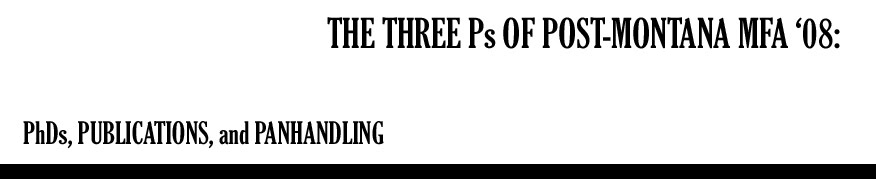
I can see some of my “checklist” completed. (an MFA, publication(s) in a national magazine, a McSweeney’s list, short story acceptance from major journal. I’m in a PhD program and about to finish a book.) And yeah, with each of these accomplishments I squealed. The successes meant I wasn’t just some hack, one of those deluded people who fancy themselves a “writer” but go their entire life writing only for themselves (and sadly, for good reason).


As I check more goals off my list, and as I suffer the inevitable disappointments that come with “getting out there,” (for every goal achieved another dream is dashed) I’ve realized the only goal you can cuddle up with at night is to not suck. I want writers who I respect to look at my work and reflect to themselves, “hey, that doesn’t suck.” Granted, this is a lowered expectation from Great American Novelist status, but I have come to accept that only Nabokov is Nabokov. Good American Novelist remains quite the achievement. I also want, ultimately, for readers to pick up my work for the pleasure of it versus "I should try and get through this."


I have new goals. I want to write a fiction novel geared more for a wider audience than literary raves. My one acceptance to the one literary journal is gathering dust and it’s time to get out there again. I would love to be in a Best American Something. I’ve been attending writers’ conferences lately, and want to spend more time behind the podium than doodling on my program in the audience.


And before I get back to work on my latest big goal (Finish and Publish My Nonfiction Book) I will share my practical, superficial and admittedly supercheesy motivator: I visualize my resume.

Wednesday, July 7, 2010

Word Choice?

What did writers do before word processing? For one, we repeated ourselves a lot more. As I revise my book I am discovering my crutch words, how I repeat not just in a sentence or in a paragraph (typo) but over the course of 300 pages (tic). I couldn’t finish Anne Rice due to her abuse of the phrase “preternatural skin.” I mean, I wasn’t looking for much, just some vampire paperback action. But even so, I got so irritated I couldn’t read. I’m determined to avoid a similar mistake.

Enter the "Find" tool, which let me know how fond I am of "documenting." I love "to document." Tasks are "documented." So are people. I even found a "documented are," the passive voice version creating a double faux pas. What's eerie is that I've written these chapters at different times over the past four years. My writing might have changed but the obsession with documenting remaints.

I know some of my crutches even as I type them. I have banned myself from the phrase "truth be told" even I have the impulse to start every third sentence this way. I lean on "now," "then" and "so" as (lame) transitions. I'll allow myself this indulgence once in a while, but I try to be sparing.

"Find" next informed me I overuse the phrase "I confess."

"Difficult" was the next to go. Originally I was searching for the word "cult," to make sure I didn't make the same Yearning for Zion joke twice. "Difficult" turned up about every fifth page. It was like finding out one in five people is an alien.

And I have a problem with inserting too many clever, quippy similes, which are like a stinky cheese——delightful in small doses, but if overindulged, impact the bowels.

Then there's when a writer uses the "only once per novel word" twice. For instance, you only get to describe a character's neck as resembling a puggaree once. A favorite writer of mine had this sort of error in her latest novel, and I gasped as if she had just stepped up to accept a PEN Faulkner in a menstrual stained skirt. Where was the editor?

Alas, It's commonly mourned how the days of Maxwell Perkins level editing are long gone. Every time someone reads my book they catch something. But I'm the final gatekeeper. Just because the editor signs off doesn't mean I should

Wednesday, June 23, 2010

What Not to Write

Writing a query letter might be about the hardest assignment ever. You have to say what your work is *about* without sounding like a complete tool. Yet while ignorance might be the reason for lameness, it's no excuse.

In that spirit, here's a link to Slushpile Hell.

Sunday, January 24, 2010

Slush: Not A Pleasing Fruity Drink

The Wall Street Journal released this article about how getting read (nevermind published) from the slushpile has reached astronomically difficult proportions. For example, The Paris Review, publishes one solicited story a year, making the odds .o08%. So, do we draw up the noose, pile up the back issues, and jump?

By way of response, I would like to say that even today, in this supposed dearth, new writers get noticed. Who ever said writing was easy? People seem to cling to these glory days when the short story market paid the bills. And when was that? And how long, in the grand scheme of writing and publishing, did that era last?

Technology has made multiple submissions easy for the writer. Writers don't have to painstakingly type manuscripts, and then wait for their return. Now they can fire multiple copies off and carpet bomb if they like. Editors, lest they wind up drowned in sheafs of paper, have had to create lines of multiple defense. Having read for a lit mag, I don't blame them.

No, you can't mail your newly minted book off to Random House and expect a response, but if you are writing and submitting good work, publication is not dreaming the impossible dream. In the past three years Montana MFAers (as in, my fellow classmates) have cracked some tough markets, including The Colorado Review, The North American Review, The Black Warrior Review, The Boston Review, McSweeney's, The Atlantic Monthly, The Mid-American Review, and The Gettysburg Review. Books by former grads (that seems to take a few more years) have been published.

A quick look at The Paris Review told me this pub is not for the emerging artist. This month's issue (for example) has work by Robert Haas and Aimee Bender. Furthermore, I don't believe it's the responsibility of every lit mag to focus on emerging writers. It's not as if Aimee Bender and Robert Haas are spamming American.

Still, I'm glad for the lit mags that give us newbies a chance. Allow me to say, thanks. And if you are an emerging writer, consider supporting a mag that supports us.

Thursday, December 31, 2009

2010 Writing Resolutions: Writing After the MFA

Writer friend Jamey Hatley shared this link on Facebook today, where PEN/Faulkner winner Ann Patchett comes to the astounding discovery that if you write you will get more writing done. I know I’m being snarky here, but this, actually, is a valid observation. The point has been made before (Stephen King makes an especially strident case in his book On Writing) but it bears repeating — writers have to treat writing as a job, or it won’t get done.

I’ll try not to quibble in that writing for Ann Patchett IS a job, i.e. she is PAID, but those of us in the fledgling ranks must flap with due diligence. Today I finished Water for Elephants (as part of my quest to read books that non grad students read). Sara Gruen apparently sat in a closet to avoid distractions as she finished. My strategy is to live alone and not have reliable internet access.

Ann Patchett says that last year, for the first 32 days of the new year, she wrote everyday. Her claim is that setting this precedent, aligning this mental juju helped. I’m signing up, along with 30 minutes a day of Pilates or yoga to lose my MFA muffintop.

You in?

Sunday, December 13, 2009

FIction, Nonfiction or Poetry? A Genre Quiz

You didn’t prepare for workshop today. What’s your excuse?

a. Sorry, too drunk.
b. Sorry, my meds were off.
c. Bumblebee.

You wrote all day today. The following describes your process:

a. Writhing in agony, pulling of hair, torrid typing, screaming, pacing, pounding of head on keys.
b. The above, but you finish the day with a hot bath.
c. Over hibiscus tea, you penciled in a comma. After a long stroll by the stream, you came back and erased it.

Characterize your intimate relationships.

a. Cradle Robbers R Us.
b. Quite healthy, actually, unless your meds are off.
c. Random pressing of bodies in narrow, wallpapered hallways.

You’ve just finished Lolita. Describe your mood.

a. I should perform the literary world a favor and shoot myself.
b. Inspired by Nabokov’s descriptive powers, a writing exercise comes to mind OR the book triggers such disturbing memories you can’t finish.
c. That first paragraph. Delightful!

Time to make money.

a. I’m going write that YA graphic novel.
b. I’m going lie about how I joined a pack of wolves.
c. It is with great sorrow that I part with my grandmother’s brooch.

Describe your perfect meal:

a. Cheeseburger and a fifth of Jack.
b. French cheese, Indonesian curry, and Mexican goat tamales, accompanied by a story of how you nearly died learning to prepare each.
c. Lavender crumpets and rainbow mist. One perfectly butchered lamb chop seasoned by the waft of a rosemary sprig.

You have no doubt by now figured which letter corresponds to which genre. If you had significant answers in a second category, congrats! You’ve discovered your second genre. You are going to be rich.

Tuesday, December 8, 2009

On Not Attending That Meeting

As I retreat farther and farther away from normal activity w/r/t writing, the web sure is a big help. In an attempt to be involved in that thing called the outside world ( meet with writers, readings, Rogers Park, Chicago) I’ve “joined” several Meetup.com groups, maybe left a tiny scrawl on the message board, then chickened out when the event time rolled around and didn’t go.

I attended a single meeting of a local writer’s group. And had a great time and met some people and learned their names. And then I chickened out and didn’t go.

I pass the Mess Hall almost daily and see a sign for the Next Objectivists Poetry Meeting. And I am joyous and excitement abounds. And then I’m too nervous to go into a room with people I don’t know and just imagine walking in and sitting down and desperately wanting—as I always do in new spaces—ask the Captain Obvious question “Is this the [insert name of event going on] meeting?” Well of course it is! But that is the only ice breaker I can conjure. I wish I had better ice breakers. (How much does a polar bear weigh?)

Yes, indeed, I am only hurting myself. Yes, indeed, I’d like to retreat into anonymity. But abandon the perks onymity has to offer?

If you search the internet, scour it enough, I bet you’ll find the traces of places where I’ve been but never went.

Sunday, December 6, 2009

My Life as Myself: A Memoir

I’ve been using the winter break to finish my nonfiction book, and after working all day every day on this project for two straight weeks (and beginning four years ago), can I just say that I am so sick of me? I’m sick of my thoughts, what I see, how I describe it, the people I meet and what I say to them. I’m sick of my observations, my musings, my jokes, my interactions and my interpretations.


Now I know why I write fiction. I want to be somebody else. Because I am freaking tired of me.


People tend to think of fiction writers as the egotists, but consider the ego it takes to write first person nonfiction. The writer has to assume that the world can’t wait to read her thoughts on whatever she feels like writing about.


This is my first book-length experience inhabiting the same narrator. Before I’ve written essays or stories from different POVs. Well, right now I don’t know that I will ever, ever want to spend over 300 pages with no one but myself again.


I’m going to Columbus tomorrow for a little road trip, Thai food and gourmet ice cream. It’s for the best.

Thursday, December 3, 2009

A Bartleby of One's Own

Maybe this is one of those "hey we've all known about this forever why didn't you" posts, but I hadn't heard of this, so I'm passing it on.

I might be giddy from our first date, but I think this is for real.

Sorry, Microsoft. We're done. And wasn't this relationship always a compromise? You were what everyone expected, but I was never happy. And your features? I am sure they will make someone very happy but they just never did it for me. Thanks and see ya.

Hello, Scrivener. Designed by a writer for a writer. Not by a robot for other robots.

I have been working on a book and reached the point of wondering just how many windows I could have open before my desktop collapsed. It's been unwieldy. Unattractive. Irritating!

Now I can have a tidy little binder to my right. And I write in any format/font I choose, and then when I export, I can create settings. I can even export as a Word document.

I don't want to be that annoying person who can't stop talking my wonderful new relationship, but if you write, and especially if you write novels or research-based projects. Check it out.

Friday, October 16, 2009

Notes, Fiction Workshop 10/15/09

Proulx, The Half-Skinned Deer. Is the soft turn enough? Subject of story is not especially original, and then all the flashbacks but gee, what language. Powers of description. The Shipping News all written in fragments. Amazing, but — don't try this at home. She always has a male narrator. Bleak landscape. Is he dead at the end? Doesn’t look good. That one red eye is creepy. Yeesh.

Stuart Dybek, The Palatski Man. His stories always seem to be about the glory of childhood. Oh, those good old days. Catholic imagery (the apple, too much? Yes. No.) but potentially justified because of the authenticity of his background. I saw him read once and I heard he draws salary from Western Michigan University and Northwestern but doesn’t really teach at either. Is that true? Interplay between the real world and the alternative world. We go down the rabbit hole into Wonderland to learn about the real world. Then we come back from it and what? We get our period?

[[[Call Regions Bank. Re: bounced check!!!]]]

[[[[And Sexual Harassment Seminar 111 Ellis at 10 a.m].]]]

POV. The “We” narrator is always an “I” really, so who is the “I” in this story? What else has been written in we? There’s that story by Aimee Bender whatsitcalled. Then We Came to the End works because “we” is this corporate, office “we” that everyone knows. Story about the mail order bride by Judy Budnitz. Any others. Hmmm.

Play with POV. You’re Ugly, Too by Lorrie Moore begins with “you” but it’s the rhetorical you, not you, then moves in into 3rd and then close third where we inhabit the interior world of the narrator.

[[[Cat food. Rhet Comp presentation Mon.]]]]

Saturday, June 20, 2009

I against I: Indolence, The Writing Life and Hauntings of Childhood Malaise

I have been unable to write a word while my sister-in-law births. This was not my intention. Grace Ann was my first “live” birth. As a relative, I love my brother’s wife and wanted to be there for her. As a writer, I was eager to bear witness. Surely this would all be material for a story someday.


Yet there was an uncanny lack of drama. The wringing of hands, the pacing, the damp brows — all notably absent. The Relative was grateful, but The Writer bummed.


8:00 Family arrives at hospital for birth.

8:15. Chris’s abdomen cut open

8:43 Baby displayed in window. Hi Baby! Hi!

9:30 Family at local Cracker Barrel for breakfast

9:38 Another plate of biscuits, please?


Sadly, I can’t blame Grace Ann, a 7 pound, zero-year-old, for my indolence. And tweren’t my belly sliced. The real problem is when I return to Alabama, I slip into this mind-numbing vortex. I become a blob held together by skin capable of nothing but watching TV and shoving processed food in her face. Think of David Banner transforming into The Hulk. Then picture the exact opposite.


I haven’t blamed my parents much in recent years, so I reckon they are due.


Growing up, my parents took me on interminable drives to “look at houses,” or to eat a Spam spread sandwich at a state park. They both possess this zen-like quality whereby they are, I swear, just that easily amused. I am not. I am a picky little bored bitch. I learned to bring a book, much like a person might make sure to carry an epi pen. On these rides (sometimes cross country) I would sit, read, and stare out the window, quietly waiting for the day my life would begin.


I’m 40. Waiting for life? Uh, this might be it. Nora Ephron tells me the neck sags at 43. That means I have three freaking years to enjoy a book tour with a neck.


So before I go home I make grand plans to begin My Great Southern Childhood Story. I pack a little sparkle notebook to capture those tiny details that have slipped into the memory abyss. For one, I had somehow forgotten those pine log trucks you get stuck behind on two lane highways. Semis that haul stacks of felled pines, red flags tied on the end. These flags, presumably, are so you can focus when the log slips, smashes the windshied and gouges out your face.


There! Wasn’t that a lovely detail? But that’s all for now. Mom has Cinemax. And I know where she stashes the cookies. Those nasty packaged cookies that I would never purchase at home. I’m going to sneak just one more. And then really, really, when I get home my life will begin.